
FAQ · NON-SURGICAL
Medical Therapy
Accurate diagnosis comes before any prescription. Once a consultation, physical exam, and — where warranted — simple laboratory studies have ruled out the conditions that mimic inherited hair loss, two objectives remain: slow the loss, and reverse miniaturization.
Two agents carry U.S. FDA approval for these purposes. Everything beyond them is compounded, and is discussed here with its evidence attached.
FDA-APPROVED
TOPICAL · 2–5%
Minoxidil
Rogaine®
Lengthens the time hairs remain in growth phase, enlarges miniaturized follicles, and increases blood flow to the follicle. Peak growth appears at 26–52 weeks, best at the crown and least at the frontal scalp.
5% outperforms 2% on hair count and weight in men — at the cost of more scalp irritation.
Only the 2% strength is FDA approved for use in women.
Stopping treatment reverses the benefit within 4–6 months.
ORAL
Finasteride
Propecia® · Proscar®
Inhibits the enzyme that converts testosterone to DHT. Trials run over five years showed slowed loss and increased hair counts in a proportion of men — again strongest at the crown, weakest frontally.
Consult a physician before starting. Ineffective in postmenopausal women; known to harm the fetus in pregnancy.
Side effects in men are infrequent — under 2% — reversible on discontinuation, and often resolving during continued use.
Tell your physician you are taking it: results of screening tests such as PSA may be altered.
COMPOUNDED IN-HOUSE
Topical hair blends
The systemic impact of topical finasteride was published in 2014 in the International Journal of Clinical Pharmacology. Three findings shaped the blend used in this practice — which sits at a lower concentration than the study's, and is applied once daily rather than twice.
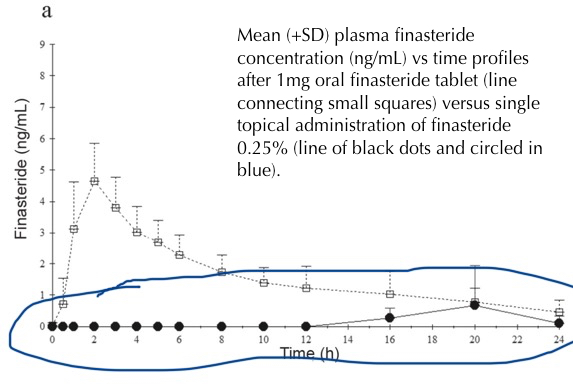
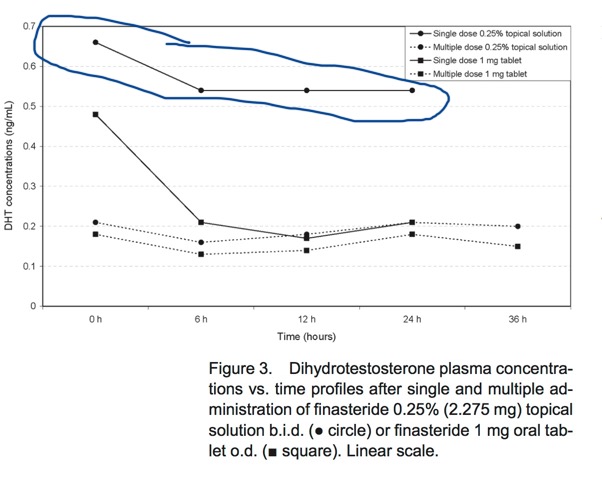
Despite these findings, this alternative to the Propecia pill is not necessarily for everyone. Safety profiles of topical finasteride have not been properly investigated at this stage.
MEDICATED SHAMPOO
Numerous cosmetic products claim to promote hair growth; few have been investigated with rigorous controlled studies. Two topical elements occasionally found in shampoos have demonstrated efficacy.
Ketoconazole 2%
Studies in men with androgenetic alopecia — using 2%, rather than the 1% sold online — showed increased hair density along with larger and more numerous anagen follicles versus a non-medicated shampoo. A likely mechanism is suppression of androgen receptor activity.
Caffeine
A potent antioxidant, identified as a stimulator of human hair growth in vitro — most likely through inhibition of 5-α-reductase activity.
WHEN MEDICATION IS NOT ENOUGH
For many patients whose medical therapy is only partly effective, advances in technique make surgery a reliably effective option. Modern approaches yield natural-appearing results that were not possible a decade or two ago — and now allow many women, as well as men in the early stages of MPB, to benefit. Previously "pluggy" transplants can often be repaired to appear natural.
PRIMARY SOURCES
- Dill-Muller D, Zaun H. Topical treatment of androgenetic alopecia with spironolactone. J Eur Acad Dermatol Venereol. 1997 Sep;9(Suppl 1):31.
- Kim JH, Lee SY, Lee HJ, Yoon NY, Lee WS. The efficacy and safety of 17α-estradiol (Ell-Cranell® alpha 0.025%) solution on female pattern hair loss. Ann Dermatol. 2012 Aug;24(3):295–305.
- Fischer TW, Trüeb RM, Elsner P, et al. Topical melatonin for treatment of androgenetic alopecia. Int J Trichology. 2012 Oct–Dec;4(4):236–245.